Edit follow-up
Note
You can edit follow-ups only if you are the owner. If you are viewing another associate's diary, you can edit follow-ups only if the selected associate is the owner.
Meetings created in Outlook or Gmail: If a meeting originates in Outlook or Gmail and is synced to SuperOffice via Synchronizer, it is read-only in SuperOffice (except for SuperOffice-specific fields like Type, Company, Sale, and Project). A plain-text warning appears at the top of the meeting dialog reminding you to edit or delete the meeting in Outlook or Gmail.
If you edit the time, date, or location of a follow-up - or delete an invitation that you created and sent - the invitees will receive a message about this.
Steps
Open an existing follow-up by double-clicking it:
- In the Activities section tab in the Company, Contact, Diary, Project, or Sale screen.
- Or, on the different tabs in the Diary screen.
Make the required changes in the dialog.
Note
If you edit a repeating follow-up, you are asked if you want to change only this instance, or this and all future instances.
Using Synchronizer: If the meeting originates in Outlook or Gmail and is synced to SuperOffice via Synchronizer, most fields are read-only. You can edit only these SuperOffice-specific fields: Alarm, Type, Company, Busy/Free, Sale, Project, Internal notes, Priority, and Completed. Everything else stays read-only to avoid changes being overwritten during the next sync.
Click Save.
Note
You cannot edit completed follow-ups until you have undone their Completed status.
Change the end time for a follow-up in the Diary
In the Diary screen, you can change the end time for a follow-up without having to open it:
Click the follow-up in the Day tab, Week tab, or View tab.
Hover the mouse pointer over the lower edge of the follow-up. The pointer changes to a double arrow.
Click and hold, then drag the lower edge up or down to adjust the duration of the follow-up. The updated end time is displayed as you drag.
Release the mouse button to apply the change.
Note
You can also change the time slot by opening the follow-up and changing the Start, End, Due, or Duration fields.
Edit repeating follow-up
Changes work in the same way as when you edit follow-ups, but when you make a change, the Repeating follow-ups dialog appears.
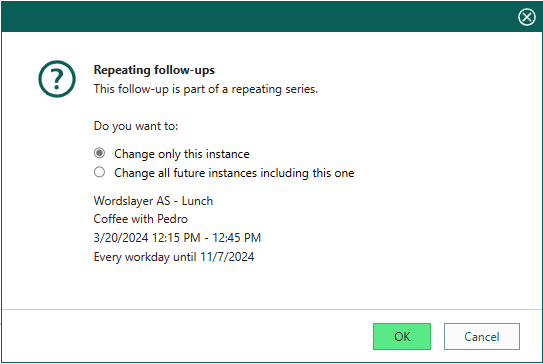
If you select Change only this instance, the change will not affect other times.
If you select Change all future instances including this one, the change will apply to this follow-up and all repetitions in the future as well.
You can change only the start date for the follow-up while viewing the recurrence details. To change the time, click OK or Cancel to return to the follow-up details.
If you decide to change the rule in the middle of a series of meetings, then a new rule is created, and the old rule is stopped at the point where the break occurs.
If you change the start time for a single meeting, the rule is not affected. The meeting is treated as an exception to the rule. The exception can be made un-exceptional by moving it back into line with the other meetings.
Caution
Modifying the start or end date on a recurring meeting after it has been saved is a bad idea. Changing the time on a recurring meeting will work fine, but changing the date will only lead to confusion. Changing the start time on a meeting will trigger an update on all subsequence recurrences if you have set the update mode to this-and-forward.
Delete follow-up using the Diary
- If you delete a follow-up you are invited to, the follow-up is removed from your Diary only.
- If you delete an invitation that you own from your Diary, this follow-up also disappears from the invitees' diaries.
- Select the required follow-up.
- Right-click and choose Delete.
- Choose Yes to confirm the deletion or No to keep the follow-up in the confirmation dialog.
You can delete meetings created in Outlook or Gmail in SuperOffice once they are more than 7 days old.
For details, see Delete items in SuperOffice CRM.